Fourteen paintings I keep returning to, with notes on the painters who made them. They range from a Caravaggio painted in Rome in 1597 to a Russian seascape from 1850 and an American Civil War landscape from the year of Lincoln's assassination. No theme beyond "things that stop me when I scroll past them."
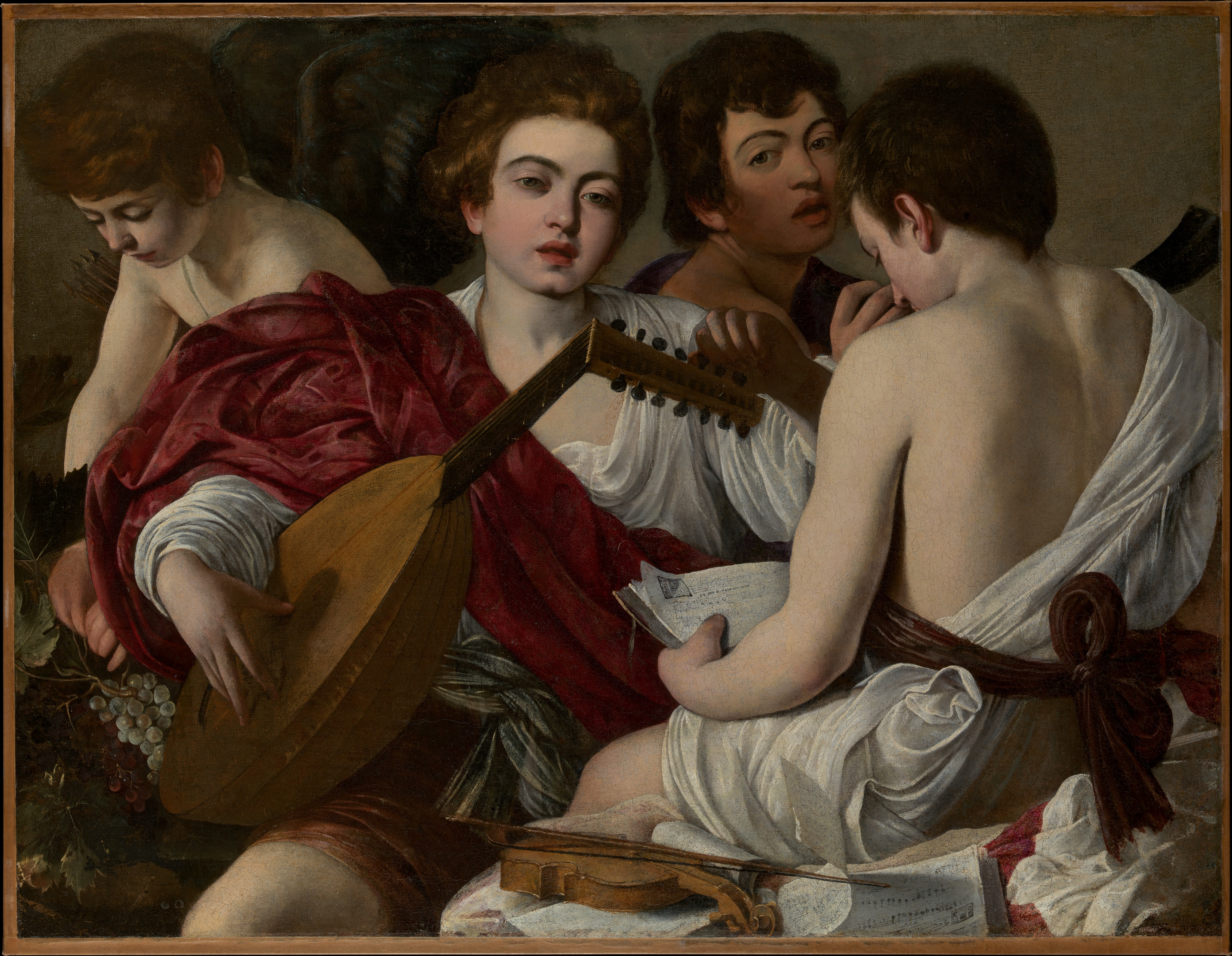
The Musicians
Michelangelo Merisi da Caravaggio
 Click to zoom
About Caravaggio
Michelangelo Merisi da Caravaggio (1571 – 1610) was the most influential painter of his generation and quite possibly its most violent. He killed a man named Ranuccio Tomassoni in a Roman street fight in 1606, reportedly while attempting to castrate him over a woman, and spent his last four years on the run from a papal death sentence, painting some of the greatest religious works ever made while bouncing between Naples, Malta, and Sicily. Court records show him arrested for, among other things, throwing a plate of artichokes at a waiter and falling on his own sword. He lost his entire family to bubonic plague by the age of 21 and died at 38 in the small Tuscan port of Porto Ercole. Possibly fever, possibly an infected sword wound, possibly lead poisoning from his own paint, possibly murder. Nobody knows. He was buried in an unmarked grave.
About the painting
One of the first works Caravaggio painted for Cardinal Francesco Maria del Monte, the wealthy patron who took him in around 1595 and gave him room, board, and models in exchange for paintings. Officially an allegory of Music (the figure on the right is Cupid, reaching for grapes), but also one of the most quietly intimate paintings of the Baroque. The lutenist's eyes are wet because the madrigal he is rehearsing is about the sorrow, not the pleasure, of love. The face peering over his shoulder, second from the right, is widely believed to be Caravaggio himself. The violin in the foreground is laid out as if waiting for a fifth player. That player is you.
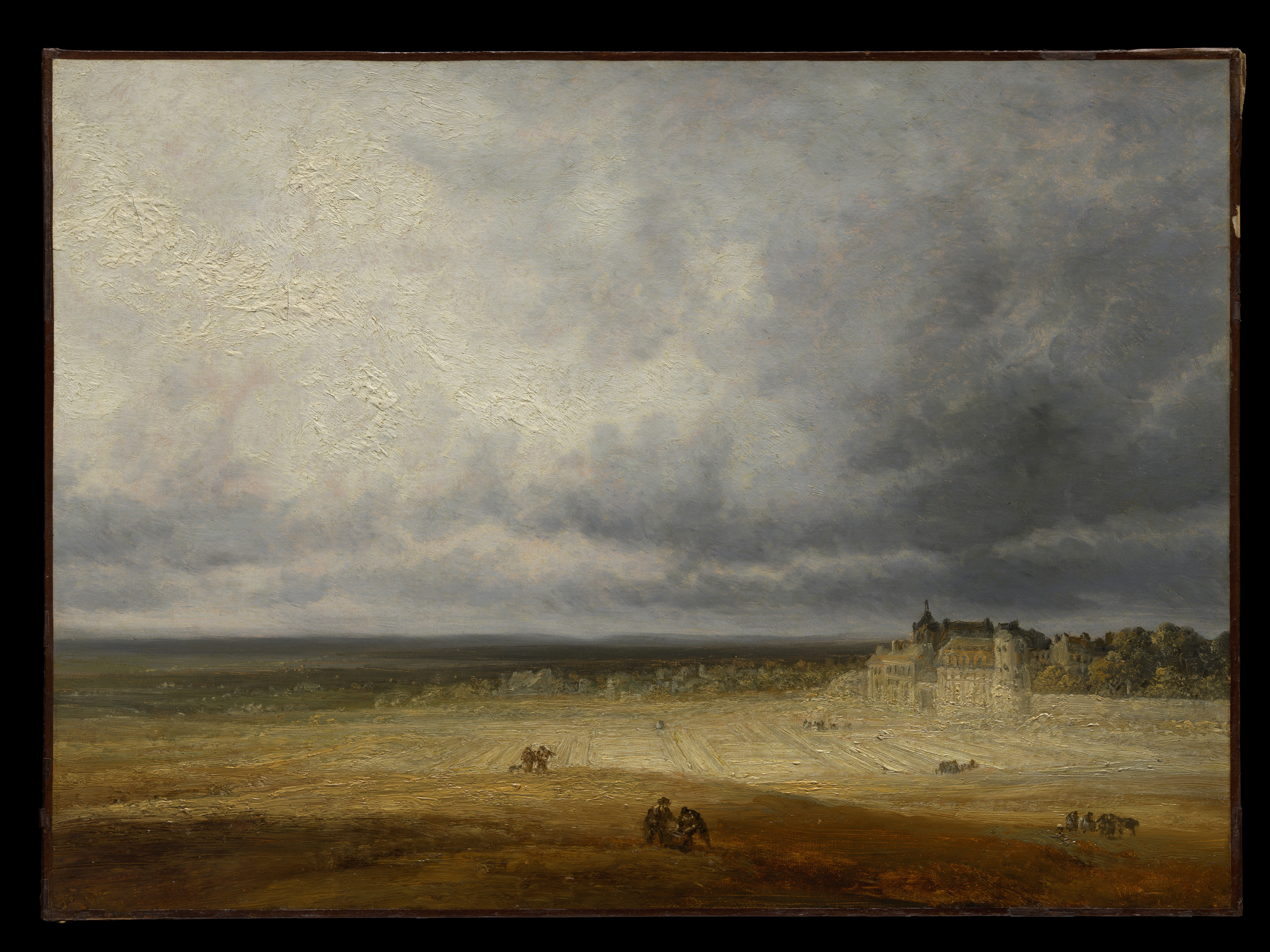
Landscape with a Plowed Field and a Village
Georges Michel
 Click to zoom
About Georges Michel
Georges Michel (1763 – 1843) lived his entire life in Paris, the son of a worker at the Les Halles market. He made his living as a copyist and restorer at the Louvre, repairing the work of Ruisdael, Hobbema, and Rembrandt and absorbing them so completely that he became known as "the Ruisdael of Montmartre." He almost never signed his paintings; his widow later told his biographer he believed the quality of the work should speak for itself, which is a noble idea that mostly resulted in him being forgotten and forged. He stopped exhibiting in 1814 and disappeared into obscurity, painting the threatened plains and windmills around Paris that were about to be swallowed by the expanding city. He is now considered the great forerunner of the Barbizon school. Van Gogh, who admired him deeply, called him simply maître Michel.
About the painting
The Met calls this an "imaginary view," meaning Michel didn't paint a specific place but the kind of place he had walked through a hundred times outside the city. The sky carries the painting. He gave skies more weight than most of his contemporaries thought was decent, and there is more drama in those clouds than in anything happening on the ground.
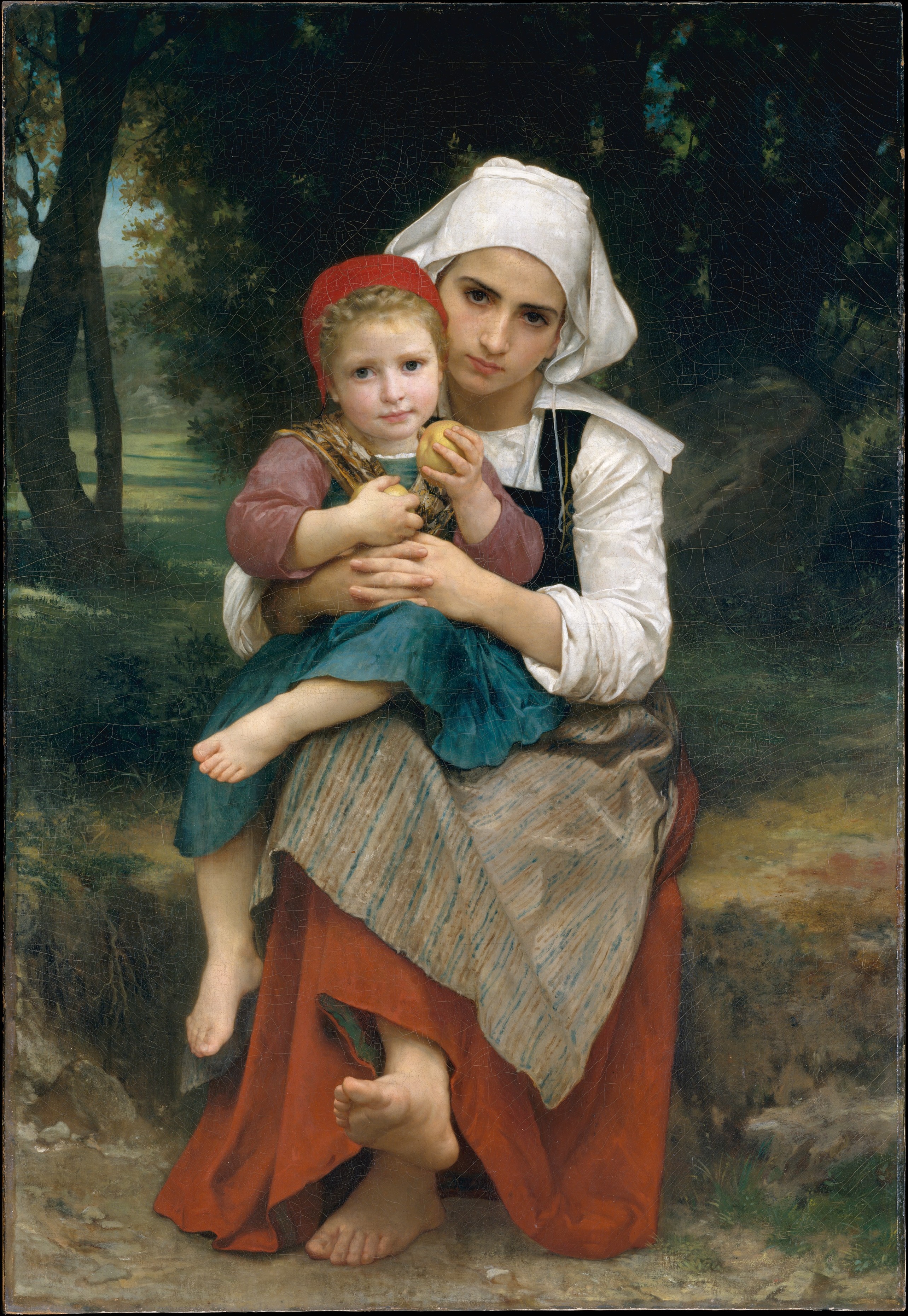
Breton Brother and Sister
William-Adolphe Bouguereau
 Click to zoom
About Bouguereau
William-Adolphe Bouguereau (1825 – 1905) was, in his own time, considered one of the greatest painters alive. He made 822 known paintings, sold many before they were finished, and once said "every minute of mine costs 100 francs." Collectors loved him; the avant-garde loathed him. Degas coined the word Bouguereauté as a slur for "slick and artificial." After his death, academic painting fell so far out of fashion that his reputation was nearly erased. He was rediscovered in the 1980s and is now firmly back in the canon.
His personal life was crushing. Of his five children, four predeceased him, including his beloved wife Nelly, who died in 1877 from complications of a difficult pregnancy, and the infant son who died two months later. He buried his last surviving son, Paul, just before his own death. He kept painting six days a week, dawn to dark, until the end. "Each day I go to my studio full of joy," he wrote late in life. "If I cannot give myself to my dear painting I am miserable."
About the painting
Painted in 1871 from sketches Bouguereau made on summer holidays in Brittany. The children are studio models in traditional Breton costume. American collectors went mad for these scenes; the painting sold within six weeks of leaving the easel, passing from Bouguereau to the Paris dealer Goupil to the New York dealer Knoedler to the collector John David Wolfe, who paid 6,000 dollars in 1871 money. Look closely at the boy's shirt. The way the linen catches light is a kind of showing-off that, to Bouguereau, was the entire point.
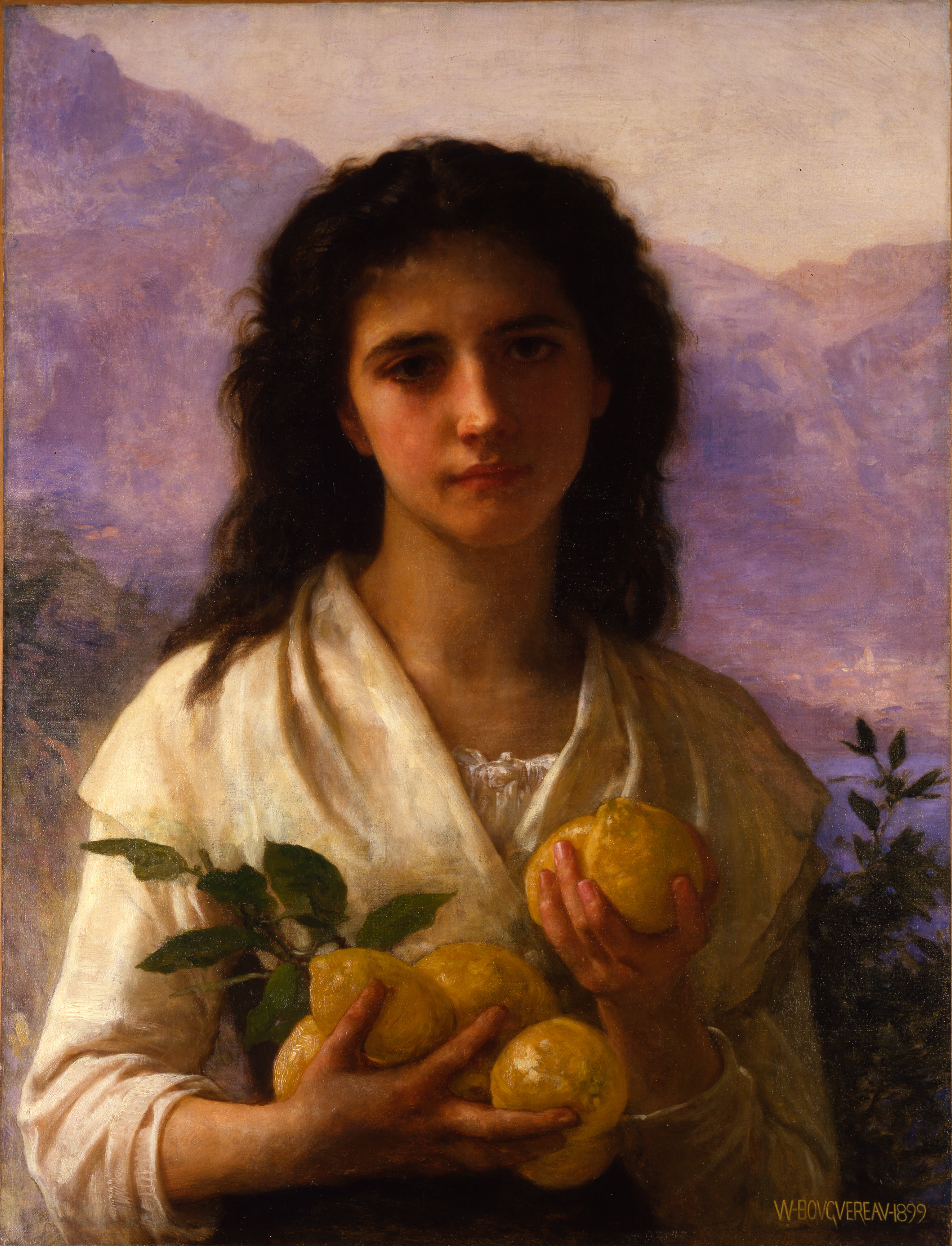
Girl Holding Lemons
William-Adolphe Bouguereau
 Click to zoom
About the painting
A late work, and you can feel it. Bouguereau is no longer interested in mythology or allegory; he is just interested in this young woman, holding lemons, and in the way yellow sits next to the colour of her skin. Painted at one of the worst points of his life: his son Paul, in his thirties, was dying of tuberculosis. Bouguereau and his second wife Elizabeth had spent months in the south of France caring for him. Paul died a year later, the fourth of Bouguereau's five children to die before he did. Knowing that, the painting is hard to look at. It is somehow both defiantly cheerful and absolutely full of grief.
By the Stream (Au Bord du Ruisseau)
William-Adolphe Bouguereau
, by William-Adolphe Bouguereau.jpg) Click to zoom
Click to zoom
About the painting
In the 1880s Bouguereau leaned hard into rustic scenes (girls by streams, peasant shepherdesses, mothers with children) and dialled back the pure mythology. Easy to dismiss as sentimental, and they were dismissed for most of the twentieth century. But spend a few minutes zoomed in on the foliage and the wet stones at her feet, and ask who else was painting at this technical level in 1888. Sargent was close. Repin was close. Nobody was closer.
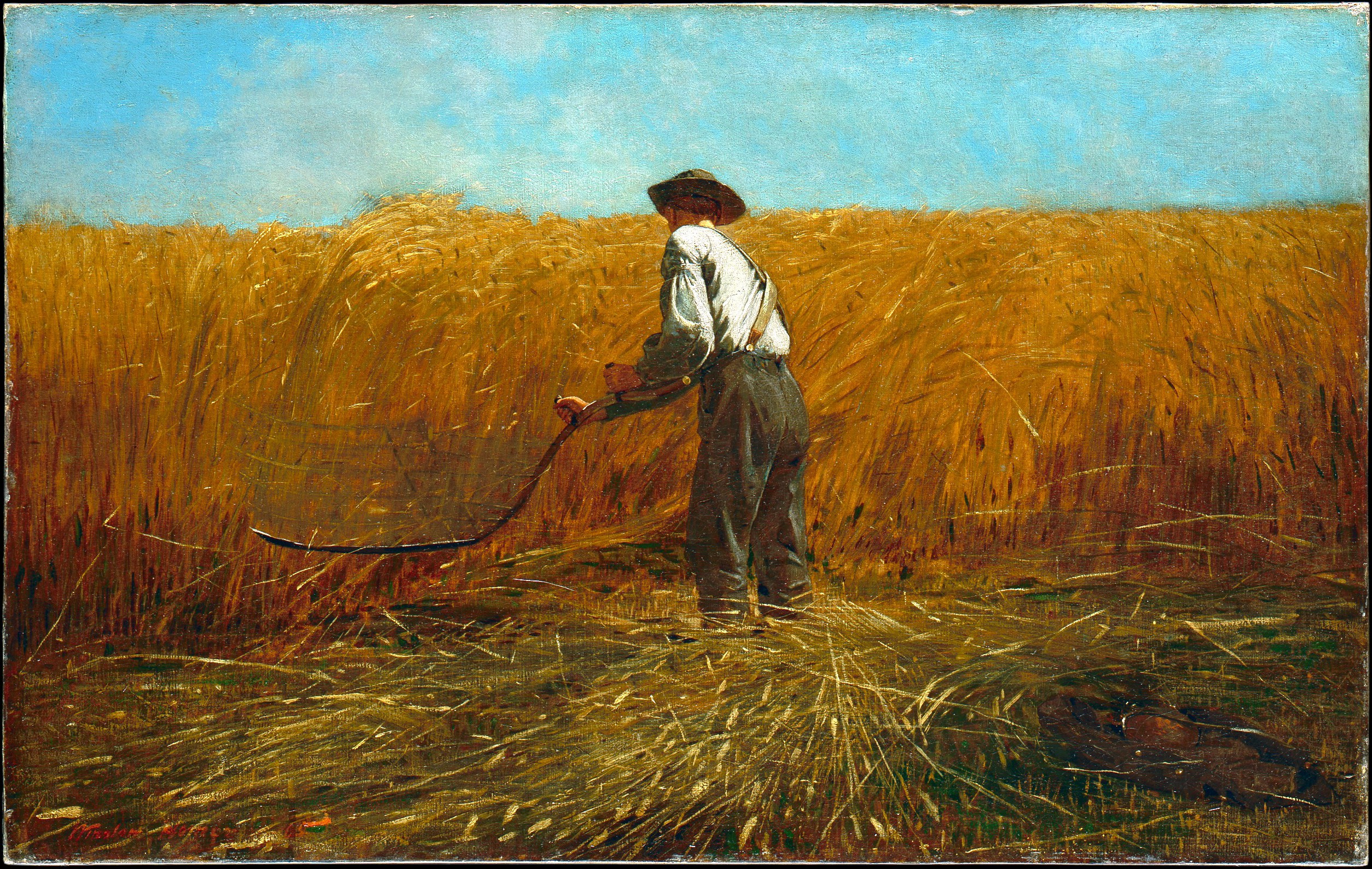
The Veteran in a New Field
Winslow Homer
 Click to zoom
About Homer
Winslow Homer (1836 – 1910) was a Boston-born, self-taught painter who got into the Civil War as a press illustrator, embedded with the Army of the Potomac for Harper's Weekly. He never fired a rifle. He made thousands of drawings of soldiers waiting, eating, marching, and dying, and after the war turned them into oil paintings. He spent his last decades alone on the rocky coast of Maine, painting the sea.
About the painting
The discarded Union jacket and canteen in the corner tell you the farmer is a returned soldier. The "new field" of the title is the wheat field; his old field was the battlefield. The phrase echoes Isaiah 2:4: "they shall beat their swords into plowshares." But something darker is going on. The bloodiest battles of the war were fought in wheat fields; a famous photograph of dead soldiers at Gettysburg is titled A Harvest of Death. And the scythe Homer painted is single-bladed and obsolete. By 1865 a real farmer would have used a cradled scythe, and an x-ray of the canvas shows Homer originally painted one and then deliberately changed it. He swapped a modern tool for the tool of the Grim Reaper. The harvest is hope. It is also death. Lincoln had been buried weeks before this paint dried.
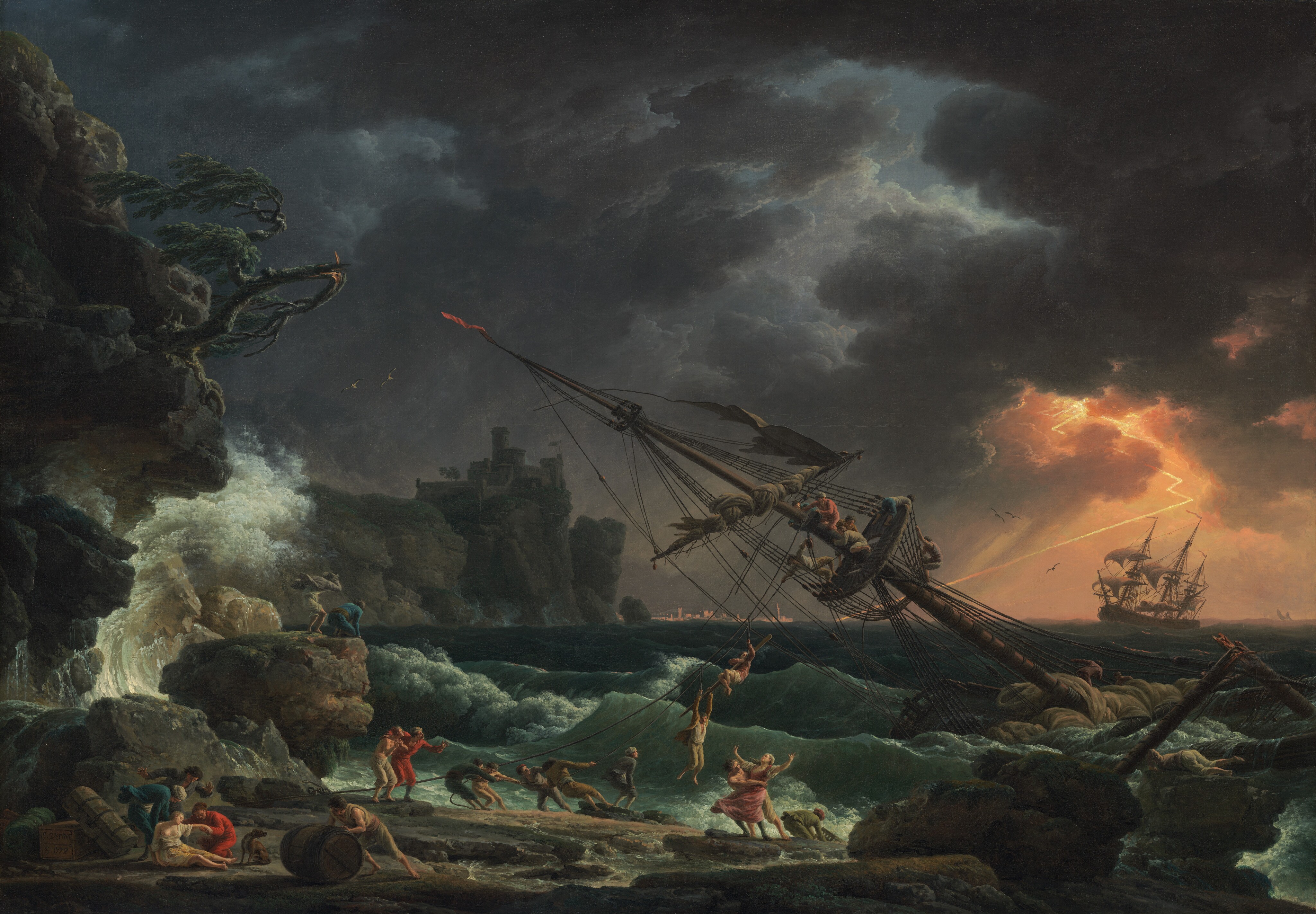
The Shipwreck
Claude-Joseph Vernet
 Click to zoom
About Vernet
Claude-Joseph Vernet (1714 – 1789) saw the Mediterranean for the first time in his teens, on the road from Avignon to Rome, and never recovered. He spent twenty years in Italy painting storms and ports for the English aristocrats doing the Grand Tour, and became so famous for his weather effects that Diderot personally commissioned a tempest from him for 1,200 livres. Louis XV called him home in 1753 to paint the Ports of France series. He died in his Louvre apartment in 1789, the year the Revolution began.
About the painting
Vernet's storms were the IMAX films of the late eighteenth century. Lightning forks down to a town in the distance; a woman lies half-drowned on the beach while another cries out to the heavens; survivors slide down a rope from the listing hull to the rocks. Notice the small dog. Vernet always put a small dog in. The painting was commissioned as one of a pair, The Shipwreck alongside a calm companion piece, because he was so famous for opposites that British aristocrats kept ordering them in sets to hang on opposite walls.
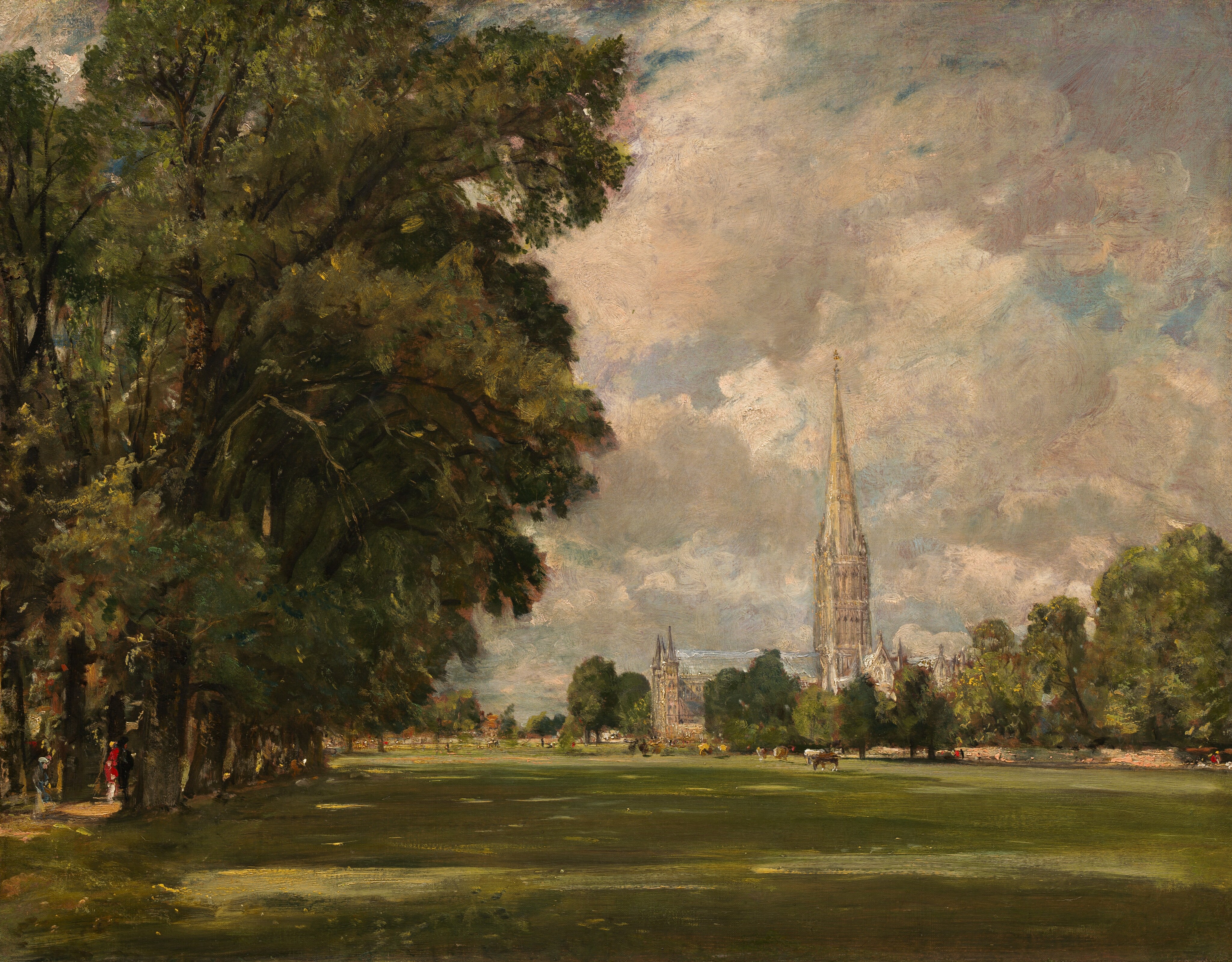
Salisbury Cathedral from Lower Marsh Close
John Constable
 Click to zoom
About Constable
John Constable (1776 – 1837) painted Salisbury Cathedral over and over for almost twenty years, partly because the Bishop of Salisbury (his close friend John Fisher) kept asking him to. A miller's son from Suffolk, he refused to take the Grand Tour, refused to flatter his sitters, refused to leave England, and was largely ignored at home while becoming wildly popular in France, where he essentially invented modern landscape painting for the next generation. His wife Maria died of tuberculosis in 1828; he never really recovered, and died in his sleep nine years later.
About the painting
The spire is the tallest in England and was already 600 years old when Constable painted it. There are several versions of this composition: the Met has the full-scale study with stormy weather, the V&A has the prime version Fisher commissioned (1823), the Frick has the 1826 version, the Huntington has a sunnier one Constable painted as a wedding present for the Bishop's daughter. He kept coming back. Look at the sky. He wrote in 1821 that the sky was "the key note, the standard of scale, and the chief organ of sentiment" in any landscape, and he meant it literally.
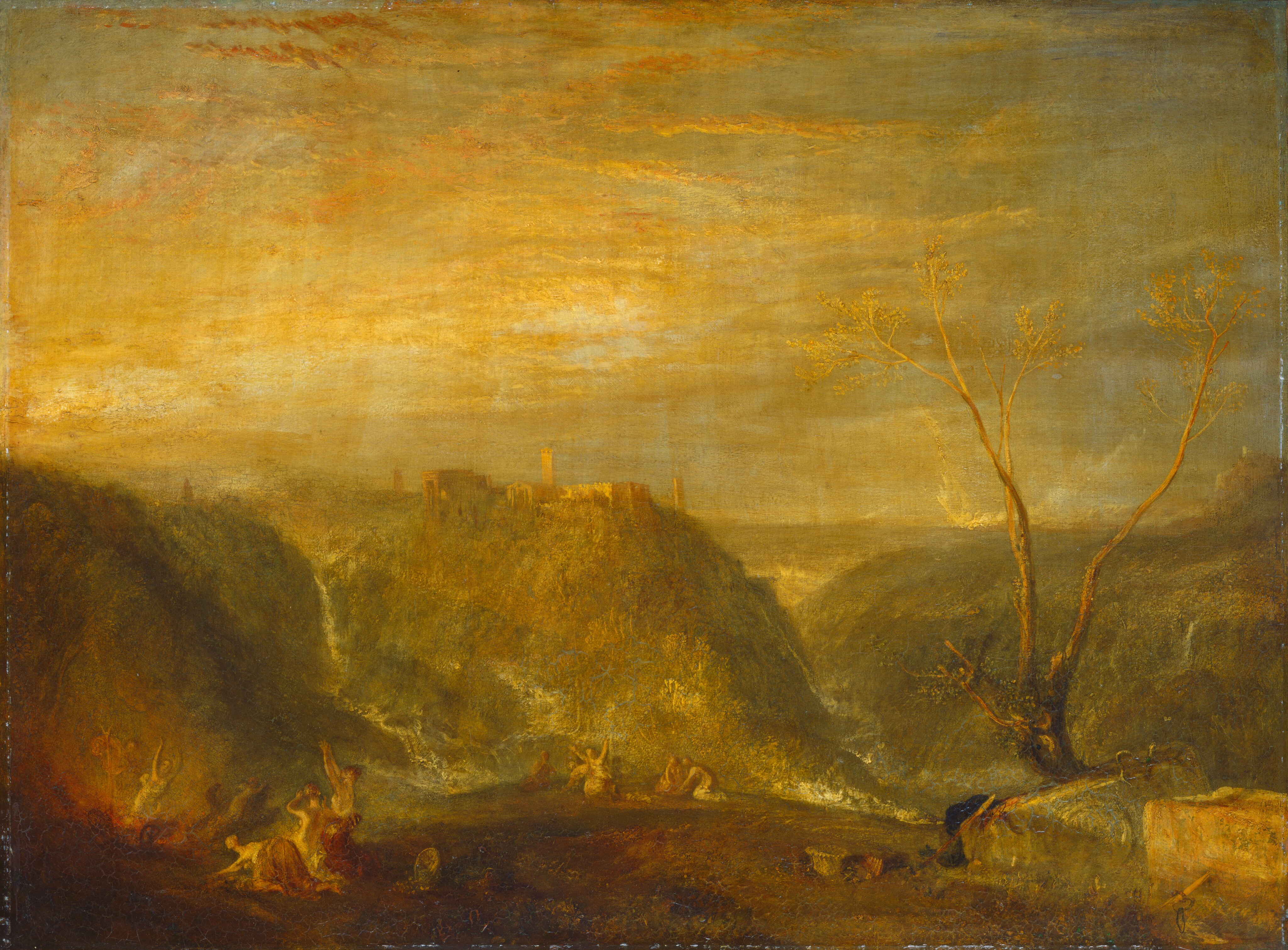
The Rape of Proserpine
Joseph Mallord William Turner
 Click to zoom
About Turner
Joseph Mallord William Turner (1775 – 1851) was the son of a Covent Garden barber and wig-maker. His mother was committed to Bethlem (the original "Bedlam") asylum when he was 24 and died there. He kept a Cockney accent his entire life, never married, fathered two daughters by a widow named Sarah Danby, and was the most famous painter in England by 30. He became increasingly reclusive with age. In 1841 he rowed a boat into the middle of the Thames so the census-taker couldn't count him. He spent his last years incognito in Chelsea under the name "Admiral Booth," telling cab drivers to drop him a block from his house so they wouldn't learn his real identity. He left over 30,000 works on paper to the British nation, and is buried in St. Paul's Cathedral next to Sir Joshua Reynolds. His last words, supposedly, were "the sun is God."
About the painting
By 1839, Turner had stopped pretending to paint things and started painting weather. The story is from Ovid: Pluto kidnaps Proserpine, daughter of Ceres, and drags her to the underworld. Where another painter would have given you a clear chariot, Turner gives you a hurricane of golden light with figures barely visible inside it. Critics in 1839 weren't sure what to do with it. A buyer once told him a painting was "indistinct." He reportedly answered: "indistinctness is my forte."
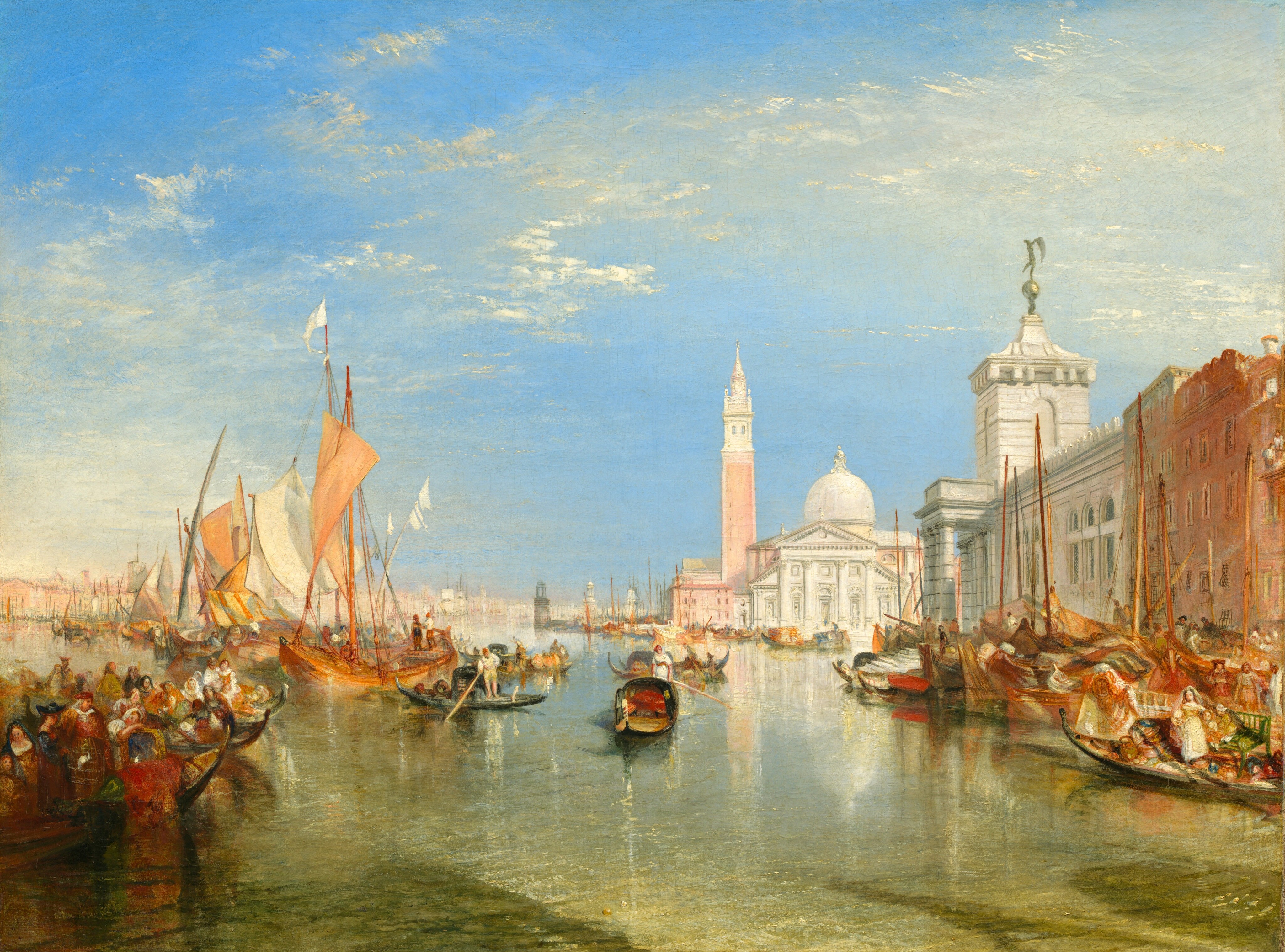
Venice: The Dogana and San Giorgio Maggiore
Joseph Mallord William Turner
 Click to zoom
About the painting
Turner went to Venice three times and painted dozens of versions of it, mostly from memory. The Dogana is the customs house where the Grand Canal meets the lagoon; San Giorgio Maggiore is the Palladian church on the island opposite St. Mark's Square. If you have stood at that spot, this painting is uncanny. The architecture is correct, the geometry is correct, and the whole thing is lit by a sun that does not exist. This is what Impressionism wanted to be when it grew up. Monet came to London decades later specifically to study Turner.
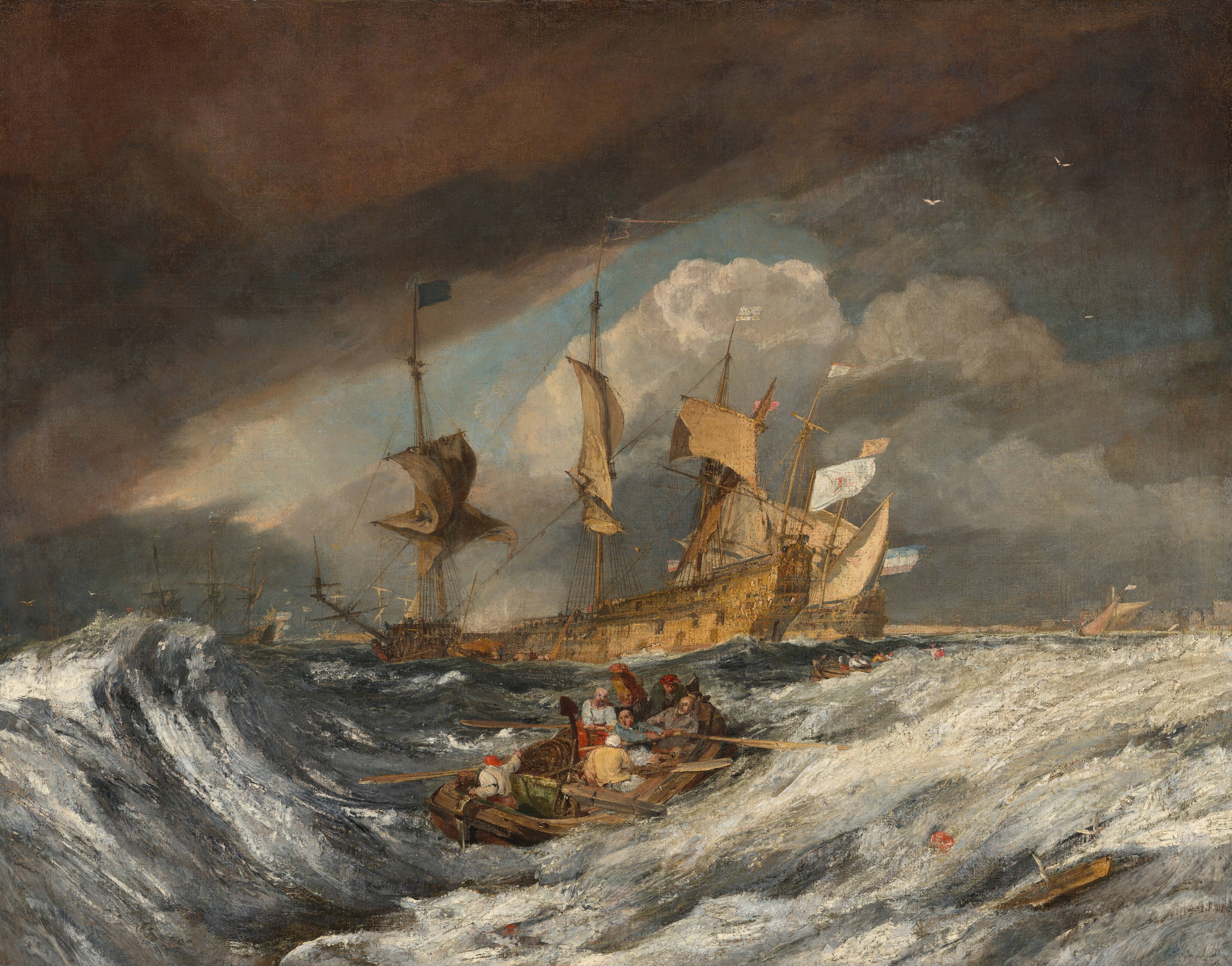
Boats Carrying Out Anchors and Cables to the Dutch Men of War
Joseph Mallord William Turner
 Click to zoom
About the painting
Early Turner: 29 years old, four years from being made a full Royal Academician, still painting with his old tight hand even as the storms underneath are starting to pull free. He painted most of it inside one of the keeper's rooms at the Royal Academy while his own studio at 64 Harley Street was being rebuilt. The men are hauling anchors so the warships can warp themselves into a defensible position. This is what naval combat actually looked like before steam: backbreaking, slow, wet labour, everyone's life depending on a piece of rope.
Intérieur du Port de Marseille
Claude-Joseph Vernet — from the Ports of France series.
 - Claude-Joseph Vernet.jpg) Click to zoom
Click to zoom
About the painting
In 1753 the Marquis de Marigny (brother of Madame de Pompadour and director of the king's buildings) gave Vernet the most ambitious commission of the eighteenth century: paint twenty-four major French ports, life-size, showing real working harbours with all their commerce and all their people. Vernet moved his family to Marseille, then Toulon, Bayonne, Bordeaux, painting from observation as much as he could. He completed fifteen of the twenty-four before the Seven Years' War ran the royal treasury dry. This is the second painting in the series. The figures on the quayside (Turkish merchants in turbans, North Africans, French sailors, ladies in panniered dresses) are advertising to viewers in Paris that this was the eastern gate of France, where the Levant met Europe. State propaganda, and one of the most beautiful things ever painted on commission for a king.
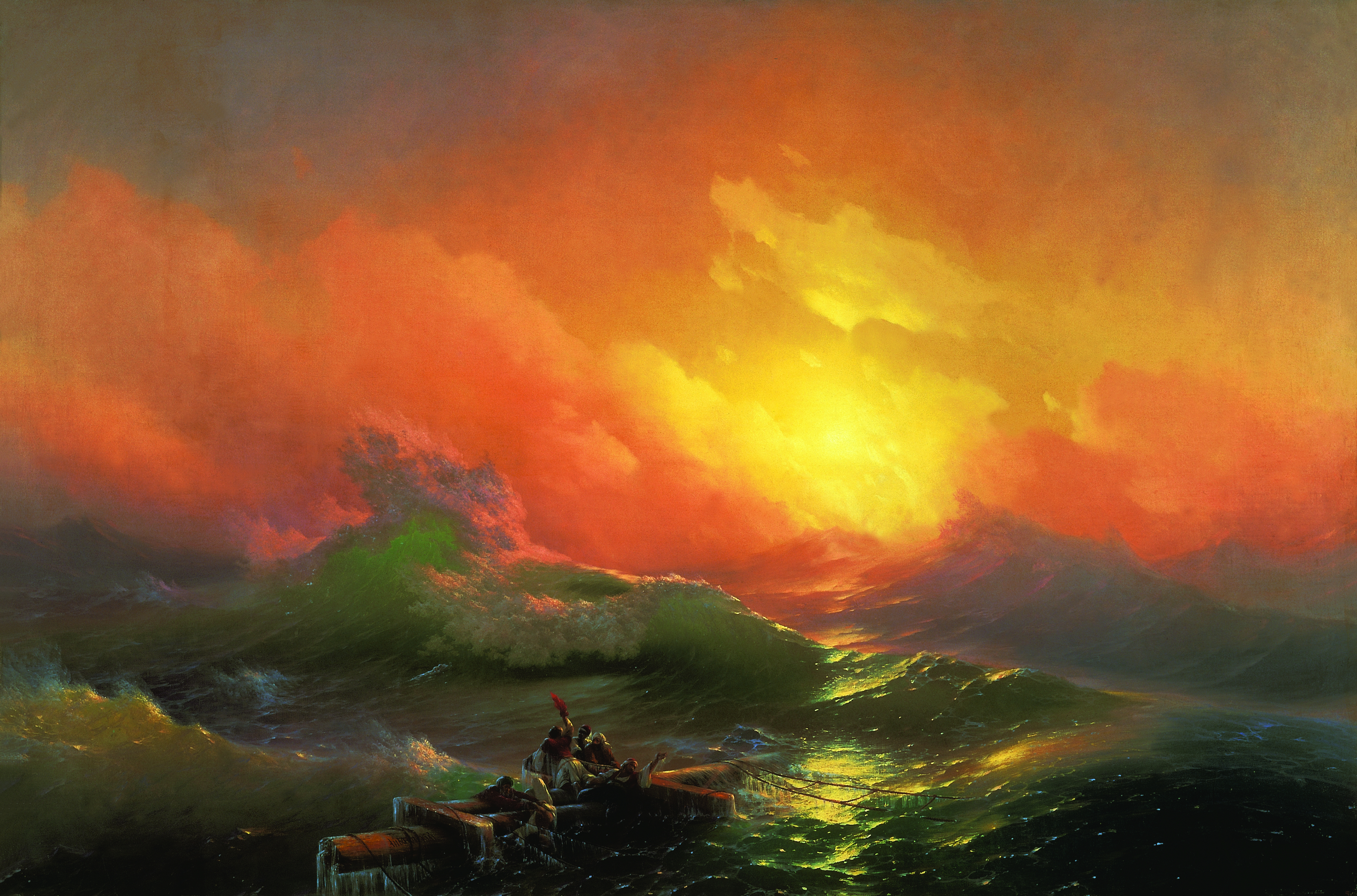
The Ninth Wave
Ivan Aivazovsky (Hovhannes Aivazian).
 Click to zoom
About Aivazovsky
Ivan Aivazovsky (1817 – 1900) was an ethnic Armenian from a poor family in Feodosia, Crimea, on the Black Sea. His birth name was Hovhannes Aivazian. He was so poor as a child that his family couldn't afford pencils, so he drew on the whitewashed walls of houses with charcoal until a local architect noticed and got him into school. He went on to become the official painter of the Russian Navy and the first Russian artist to receive France's Legion of Honour. Chekhov said the phrase "worthy of Aivazovsky's brush" was the cliche Russians used for something too beautiful to describe. He produced roughly six thousand paintings in his sixty-year career, about one every four days. Late in life, when the Hamidian massacres of Armenians began, he threw all the medals the Ottoman Sultan had given him into the Black Sea.
About the painting
The "ninth wave" is an old sailor's term: waves come in groups of nine, and the ninth is the one that kills you. The painting shows the morning after a storm. A handful of survivors cling to a piece of broken mast; if you squint, the wreckage forms a cross. The light coming through the storm clouds is unlike anything else in nineteenth-century painting. It almost glows. The greens and aquamarines of the rising wave are translucent, achieved by glazing thin layers of pigment over a paler underpainting, the same technique the Old Masters used for skin. Aivazovsky painted from memory, almost never from life. He had stood on the shore at Feodosia his entire childhood. He didn't need to look.
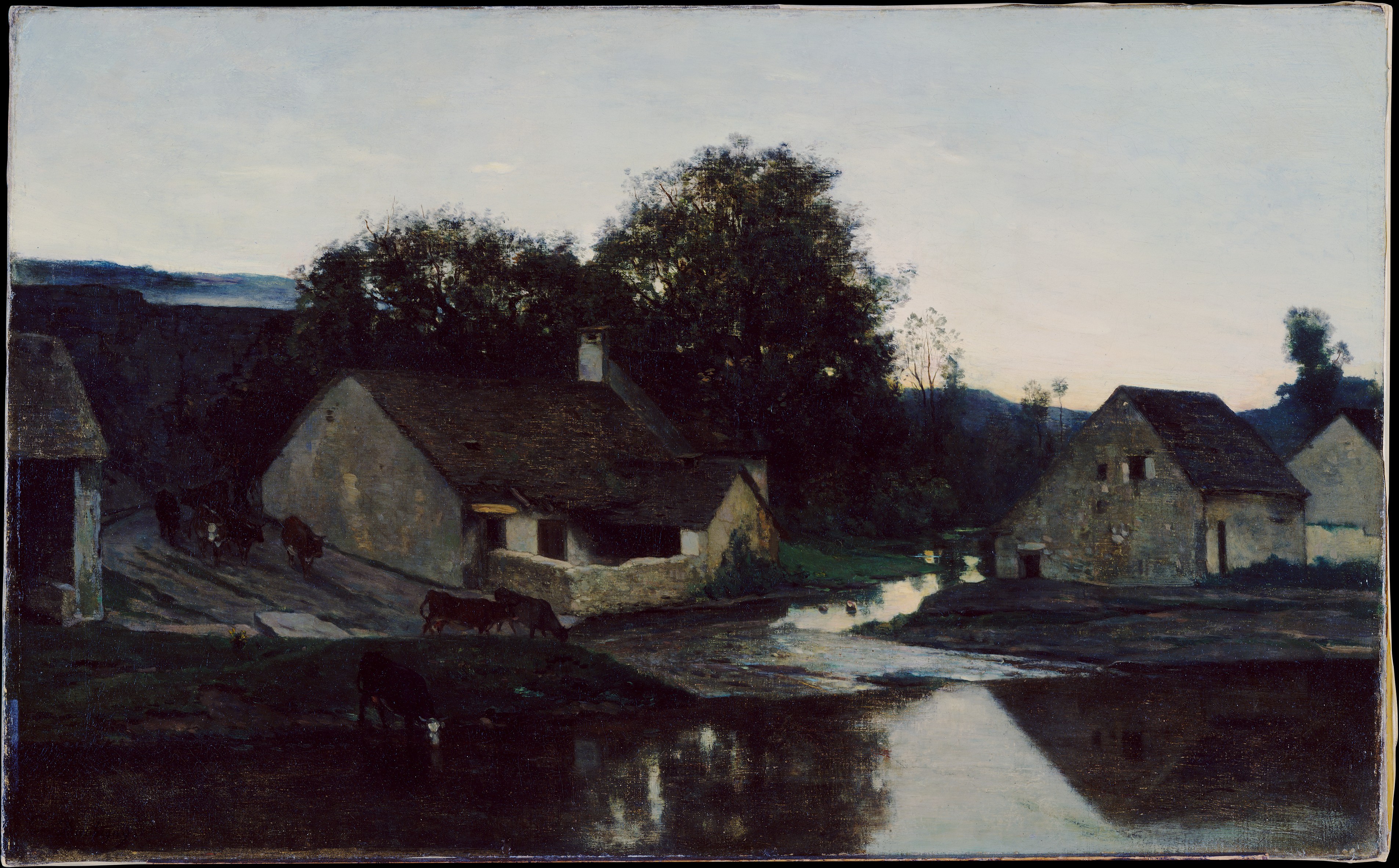
The Hamlet of Optevoz
Charles-François Daubigny
 Click to zoom
About Daubigny
Charles-François Daubigny (1817 – 1878) was the bridge between the Barbizon School and the Impressionists. Born in Paris into a family of landscape painters, he was sickly enough as a child to be sent to the countryside to be raised by nurses, which is probably where he learned, before he could read, that landscape was the most important subject in the world. In 1857 he bought a small boat, christened it the Botin, and converted it into a floating studio on the Seine and the Oise. He would drift downriver and paint whatever was on the bank. Monet picked up the same idea twenty years later and got more famous for it. When Daubigny died in 1878, Van Gogh wrote in a letter:
It must be truly good, when one dies, to be conscious of having done a thing or two in truth, knowing that as a result one will continue to live in the memory of at least a few, and having left a good example to those who follow.
Van Gogh painted Daubigny's garden three times in the last weeks of his own life.
About the painting
Optevoz was the place where Daubigny figured out who he was as a painter. He met Corot there in 1852 and the two spent weeks sketching the same valley. You can feel the moment in the brushwork. Earlier Daubigny is fussy and detailed; later Daubigny is loose and modern. This painting sits exactly between the two. It is also, of everything in this post, the smallest dramatic statement. Nothing is happening, nobody is dying, no one is being abducted by a god, no storms, no wars. A pond, some cottages, evening light. It is almost the opposite of Aivazovsky and Turner, and I keep it in the same folder on purpose.